Year-End Direct Mail Fundraising: 5 Strategies for 2025
With year-end fast approaching, direct mail programs are cementing their strategies for end-of-year campaigns and considering the small details and touches that can finalize this year’s stories, strategic approaches, and artwork to maximize the impact of their efforts.
Our second annual Direct Mail Fundraising Strategy Report is here to share some of the strategic and creative trends that are top-of-mind this time of year. We’ll take a close look at the tactics that performed well last year-end and dig into how they have impacted strategies in 2025.
Each year, our team is excited to celebrate the successes of our partners and the work that helped them drive essential revenue for their world-changing missions. The strategies below are developed from the approaches that helped our partners meet their goals at End of Year 2024 to drive:
5% year-over-year revenue growth through direct mail campaigns
Results in 2024 showed significant variance from one organization to the next – and we expect to see that wide range of outcomes again this year-end, depending on what market space nonprofits fall into, especially in a 2025 giving landscape saturated with breaking news, international conflict, and domestic uncertainty. But with a close eye on the methods and tactics that move the needle, it is possible to increase your year-over-year results even in challenging environments.
Read on for the five strategies we’re focusing on with our partners this end of year to help their direct mail campaigns power critical revenue:

1. Response rates increase at EOY. Don’t be afraid to lean in and mail more!
We see many direct mail programs making between 30-45% of their total annual revenue between October and December. With this in mind, we advise many of our partners to take advantage of the higher levels of responsiveness at peak times of year with a few best practices and motivational techniques:
Review your cadence. Your donor file can often support increased drop dates during these high-traffic windows. Many organizations double their solicitation in the final months of the year.
Target audiences strategically. Utilize low-cost follow-ups – like postcards and smaller formats with a combination letter/reply – and identify the best audiences to target with additional sends to expand the cadence of your mailings in a strategic way.
Leverage matching gifts. An impactful tool for driving increased response, matching gifts can be tested for the match multipliers and variants that drive the highest response.
 PLANNED PARENTHOOD FEDERATION OF AMERICA
In a heightened state of uncertainty leading up to year-end in 2024, Planned Parenthood Federation of America scaled up their cadence with a direct mail package for both their low-dollar program and President’s Circle (midlevel audience) when Trump was elected last year. This campaign was sandwiched between two year-end match campaigns, but still performed extremely well – it added more overall revenue without cannibalizing other campaigns at the same time. In 2025, they’re holding space in their calendar for a rapid-response mailing in case the need to scale up arises again.
Our takeaway: Adding a campaign to our calendar did not hurt performance across mailings – we mailed more, and we made more.
2. Plan for Giving Tuesday – It’s not just for digital anymore.
We’ve found this to be especially true for higher dollar donors. Among our partners, we’ve seen testing a postcard send to this audience has driven strong results. This is especially impactful due to a recent trend in digital: promotion around Giving Tuesday stretches earlier, and longer, every year. With a widening window for this major charitable giving effort, the option to include campaign add-ons in the mail becomes more optimal. We’re seeing nonprofits leverage this giving day differently across different programs:
 JANE GOODALL INSTITUTE USA
This year, to gauge the impact of Giving Tuesday messaging in their mail campaigns without dedicating a full mail package, we’re testing a call-out to Giving Tuesday on reply devices during a seasonal campaign for the Jane Goodall Institute USA (JGI).

We’ve also built language around Giving Tuesday into our messaging by updating acknowledgment copy to reference Giving Tuesday for any packages that mail in early November and updating landing pages for direct mail online gifts to reference both Giving Tuesday and End of Year. And for major donors, JGI also created a self-mailer with a specific Giving Tuesday appeal.
3. Integrate your mail campaigns seamlessly with a few small touches.
Over the past five years, we’ve seen significant growth in vanity URLs, which are now generating up to 15% of direct mail revenue for organizations at year-end. By including and optimizing these URLs across your campaigns, you offer audiences another easy way to make their gift.
Similarly, QR codes are increasing in popularity and becoming more recognizable every year to direct mail audiences. This year, including a QR code in our mail campaign can unlock postal savings – and they don’t have to direct only to donation pages. QR codes can also be used as engagement opportunities and a means to go deeper with messaging and creative during critical fundraising periods like year-end.
Small touches like these can have a big impact on integrating your campaigns across channels, and they’re a detail that you may still be able to implement in your campaigns ahead of year-end.
4. Lean into testing at year-end to gain insights for 2026 strategies.
With higher volume and response rates comes an increase in potential learnings to be gained from testing. We work with our partners to test into the most optimal audience response rates to matches, goals, and deadlines, among other tactics and details from ask strings to call-out boxes.
 HILLEL INTERNATIONAL
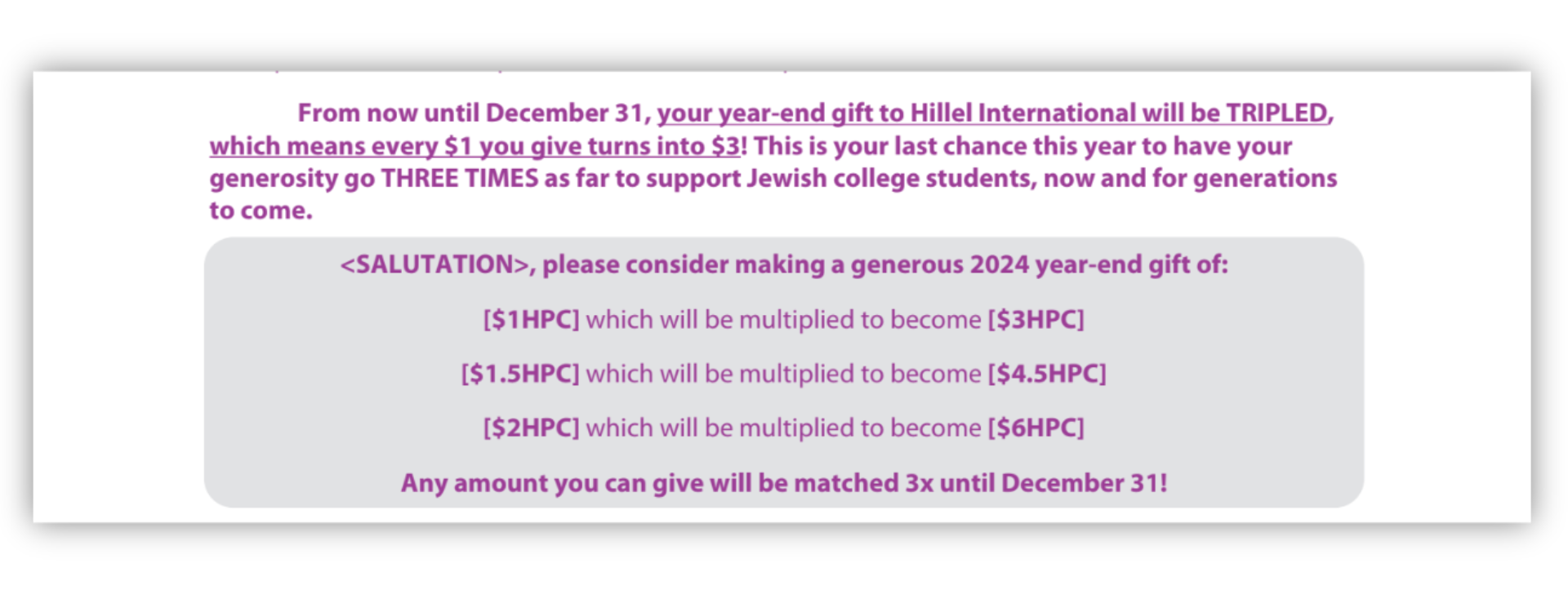
Last year-end, we tested a shaded box for Hillel International versus a more narrative CTA on the letter. And just this element lifted the average gift by 21%, return by nearly 40%, and $/M by nearly 70%. This tactic was rolled out across 2025, including the year-end campaign.
5. Appeal directly to your DAF donors with dedicated campaigns at EOY.
By gaining an understanding of who your DAF donors are, you can optimize your messaging specifically toward DAF giving for this audience by making small adjustments to your existing campaigns. Because we see DAF giving significantly increase near year-end, this is a highly impactful time to appeal to this growing and valuable audience. We recommend testing DAF-specific call-outs, CTAs, and QR codes, as well as higher placement of DAF fields on the donation landing pages that donors are directed to from mail campaigns.
PLANNED PARENTHOOD FEDERATION OF AMERICA
In 2024, we tried appealing directly to our DAF donors by segmenting this audience and focusing all of their packages and asks around their DAF giving. We saw the impact in our results when their DAF giving at year-end exceeded prior years’ revenue by 25%.


This year-end, our partners are mailing powerful and urgent campaigns in a year when many programs are facing increased need and a challenging giving landscape. By telling incredible stories about their mission and work, and optimizing those efforts to maximize response, they are driving the highest possible impact – and we can’t wait to see and celebrate the results of all their incredible work.
For more tactics and steps to optimize your EOY campaigns across channels, check out our 2025 EOY checklist. And for creative insights and strategies to leverage at year-end, read Five Essential Elements of a Standout EOY Campaign from our art and content directors.
Next insight