Strategic planning
The Right System for the Mission: A Q&A with BWF Zuri’s Experts
Christina Pulawski, AVP Management Consulting, BWF Zuri
Wayne Combs, AVP Management Consulting, BWF Zuri
Karen Nicoletti, Director of Marketing Content, MissionWired
With every campaign, nonprofit and mission-driven fundraisers navigate precise donor communications strategies to ensure their messages reach the best audiences with the most relevant appeals, optimized to make donors feel seen and to encourage them to deepen their connection with an organization’s work and mission. So what happens when it feels like your technology system is getting in the way of those efforts?
For fundraisers facing challenges with their CRMs, it can be worth taking the time to zoom out and take a look at the big picture – the best solution for your challenge may look different than you first expect. Our teams at MissionWired and BWF Zuri are dedicated to making sure nothing gets in the way of executing your most ambitious fundraising campaigns. Rather, technology should be a powerful tool to support and enhance what’s possible for your donor communications.
To dig deeper into the kinds of system challenges that may be getting in the way of nonprofit donor communications, and to highlight some of the most impactful solutions, I sat down with two system selection and implementation leaders from our partners at BWF Zuri, Christina Pulawski and Wayne Combs, to talk about how they help their clients ensure their systems are working as smoothly as possible to support their mission-sustaining work.
KN: What should mission-driven organizations expect from their CRM?
CP: It can be tempting to think about a CRM as a database, a sort of online Rolodex, which is a static thing, but in reality, a CRM is far more dynamic. CRM is less of a pond and more like a stream or river that helps keep things moving and helps us engage with the constituents represented within it. Your CRM automates processes and helps you experience data in such a way that you can diagnose challenges, easily see what needs to happen next, test things, and measure outcomes. When a CRM is working at its best for your program, it’s a powerful tool for enabling strategic decision-making to support effective donor communications.
When a team is feeling like their system isn’t working for them, there’s often more diagnosis to be done. Your technology is just one part of a larger ecosystem that also includes how the data is stored and processed and how information is delivered. That’s why our team will begin a partnership by asking questions to further understand that full ecosystem. We have a diagram that I think can be really helpful at illustrating all the other elements at play alongside a CRM:
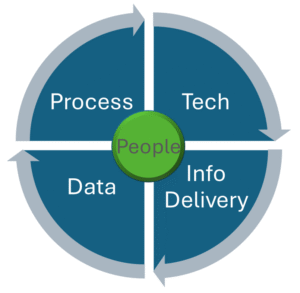
WC: Data is often the first place to look when a CRM feels like it is getting in the way. If an organization can’t easily segment audiences, understand donor behavior, or tailor messages based on what supporters care about, the system may not be the only issue. It may be how the data is stored, governed, and connected across the larger technology ecosystem. That foundation really determines whether teams can communicate with donors in relevant, timely, and meaningful ways. Without it, even a new technology platform can recreate the same frustrations in a new environment.
KN: When an organization is making that decision whether to optimize, upgrade, or replace their system, how do you help guide that decision-making?
CP: The assessment will be different for each unique organization that we work with, but we’re essentially taking our partners through diagnostic exercises to identify the root cause or causes of their challenges. We’ll look at all the elements involved alongside the technology: process, information delivery, and data, to identify which of these elements are actually out of alignment. We talk to everyone – front-end and back-end teams may have very different impressions about how the current system is performing, and that is important to uncover as well. And the people element, always at the center of it all, is the most complex and nuanced.
WC: These conversations serve as a pulse check. We often ask: What can’t you do with your current system today? Talking through that question from different stakeholder perspectives often helps a team diagnose the issue for themselves. Sometimes, it reveals solutions within the organization’s current environment that can address the problem without requiring a full system overhaul.
CP: Yes, and sometimes the solution won’t begin with a new technology system. For one of our partners, our assessment revealed that their staff had knowledge gaps that prevented them from being able to effectively leverage the full capabilities of their existing system, much less a new one. Our advice to them was to develop their teams before going shopping for a new system, so they could make the most of whichever CRM they ultimately chose.
When you think about going to the doctor to diagnose a health issue, you wouldn’t want them to follow some pre-determined checklist to resolve every issue you raise separately. You’d want them to ask about your family history, your medical history, to ask questions that you wouldn’t have thought would be relevant, but their knowledge and years of seeing patients will inform their diagnosis. You’d never think that bump on the elbow a few months ago had anything to do with your headache, would you?
Our approach at BWF Zuri is similar – we’ll look at your team’s drivers and motivations, audit processes to identify potential efficiencies, build out or assess your existing systems map, take budget constraints into account, and consider your team’s readiness to transition to, use, and support a new environment, all before talking about how switching your system can help solve your challenges.
KN: When your assessments do find that an organization needs a system replacement, what does that look like?
WC: A replacement is worth serious consideration when the organization can’t get the information it needs to make decisions or communicate effectively with donors. That can look like disconnected systems, duplicated data, a lot of manual work, or reporting that takes so long to produce that it’s no longer useful. When teams are constantly exporting, uploading, reconciling, and working around the system just to send basic communications or understand performance, the technology is no longer supporting the strategy.
CP: Essentially, it appears as a mismatch between your requirements and your system’s ability to meet them. This can flow both ways: on one hand, a client may have a high-performing but simple operation and a tool that is overly complex with high overhead to maintain well. On the other hand, a client may have unique and wide-ranging business needs, growing out of their system that wasn’t designed to support that complexity.
For some it’s a matter of thinking about your system as a communication tool. Is it meeting your audience’s expectations? Audiences will be comparing your user experiences with commercial interactions, and if you’re seeing engagement results slide because your system isn’t keeping up, that can be another flag.
We’ve also worked with organizations that were running on systems so antiquated that finding support was becoming a bigger and bigger challenge, and they began losing staff because teams didn’t want to work with the older system. Sometimes it comes down to understanding even broader drivers: an organization-wide strategy might evolve to favor a unified platform underpinning all business applications for compatibility and integration purposes.
KN: Once an organization makes the decision to undergo a system change, what makes BWF Zuri unique in how they support that transition?
WC: One of the most valuable things we bring is an objective and experienced perspective. Internal teams often have assumptions about what the problem is or what the right solution might be. Our role is to help the organization step back, look at the full landscape, and evaluate options against its strategy and operations. That outside clarity can help teams make decisions with more confidence, build alignment across stakeholders, and avoid solving the wrong problem with the wrong tool.
CP: Yes, and when we share back what we’ve seen and heard in our assessment, we make sure to present two to three options, with our take on what the various outcomes, pros, and cons will be for each choice. Remember, a system change may not be swapping out a CRM, but perhaps evolving the technical ecosystem in other ways.
Importantly, we do not provide direct product recommendations: We are system agnostic with deep experience working with the major CRMs in the marketplace, and neutrality is another powerful asset we offer. But we’ll help our partners go shopping, with resources like detailed requirements customized to their environments, encompassing all business and infrastructure considerations to help organizations understand in precise, granular details the capabilities and limitations of each CRM against their needs. We also help the team with decision support and governance counsel, to ensure that the organization’s decision considers all stakeholder lenses.
WC: Our strongest partnerships happen when everyone comes to the table open to possibility, rather than anchored to a preconceived idea of what the solution should be. That openness is what helps teams choose solutions that are not only technically sound, but are also sustainable, adopted, and aligned with how they want to engage their community.
CP: Exactly, because when everyone is open to possibility, willing to really dig in and investigate the root cause of their challenges, and consider every avenue for solving those issues, that’s when we can work together to make some really transformative changes to support the way your team works with each other and the way your organization connects with its audience.

Zuri Group is now BWF Zuri
In June, MissionWired acquired BWF to join forces with Zuri Group as one unified and powerful team. By combining BWF’s decades of strategic fundraising expertise, campaign management, donor engagement, and predictive analytics with Zuri Group’s deep technical mastery of systems architecture, custom development, and digital solutions, BWF Zuri provides comprehensive, end-to-end fundraising solutions for higher education, health care, and nonprofit organizations worldwide. By combining deep industry expertise, innovative methodologies, and specialized talent, BWF Zuri helps organizations strengthen fundraising performance, deepen donor relationships, and create lasting impact in a new era of philanthropy. Learn more here.

Imagine: Your donor communication strategy is everything you want it to be...
What challenges or pain points are getting in the way of making that ideal a reality? This month, we’re asking nonprofits to tell us more about their donor communications challenges – share yours with our team in this quick, one-question survey!
We’ll be sharing more insights like this from our nonprofit leaders, with strategies for leveraging the latest in data and technology to make your donor communications daydreams a new reality. Stay tuned for more – and sign up for our Recurring newsletter to stay in the loop when the next strategies drop!
Next insight